

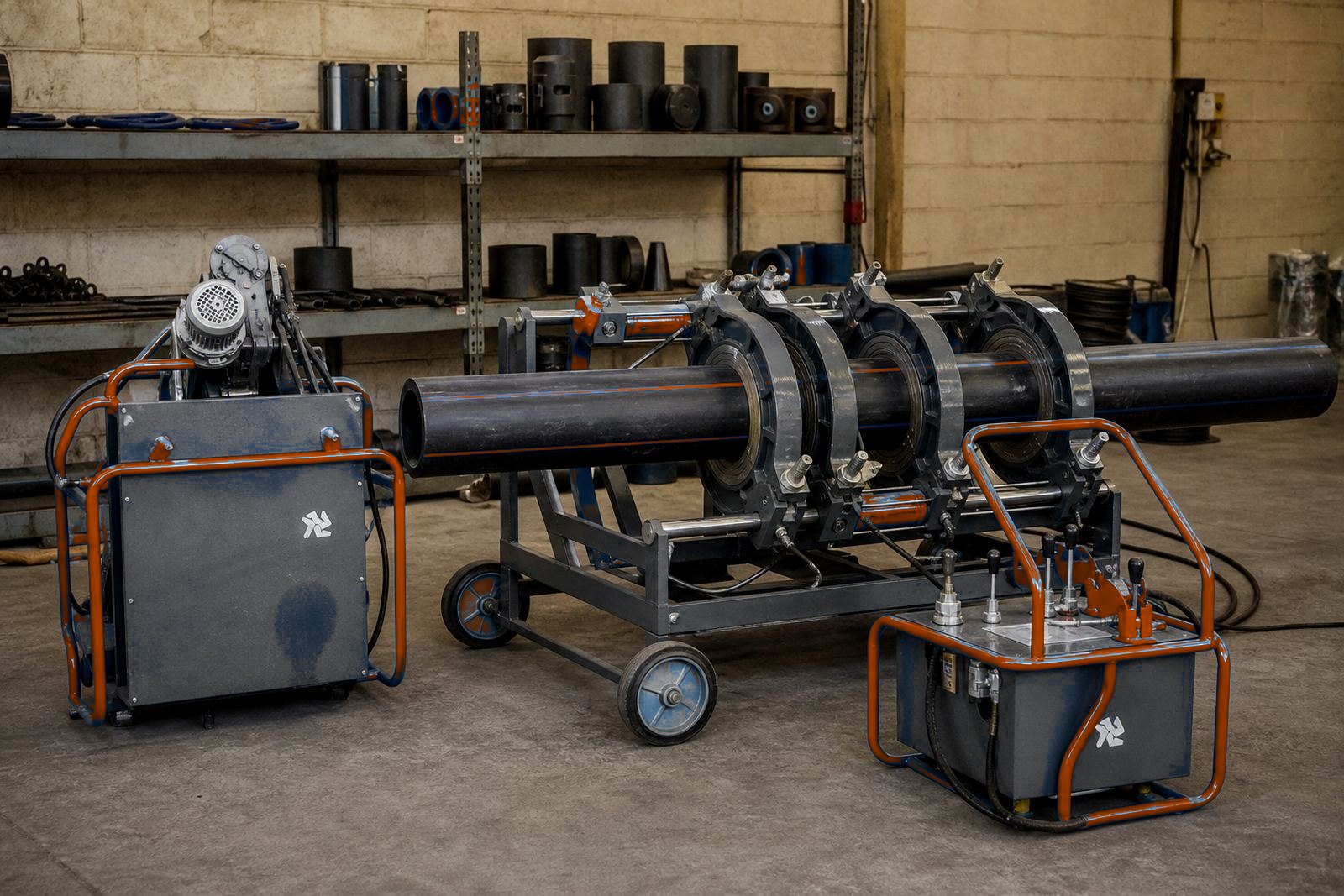
The first jobs were about making pipe joints behave
In the early days, we worked directly with local clients. Contractors needed butt-fusion machines that could hold alignment through every joint. That is still the core of the trade, and it shaped how the business was built. Wrong-looking beads are read before the next joint goes in.
HDPE pipe jobs vary widely from site to site. Different SDR ratings, different diameters, different trench conditions and different crews all change the way a weld is handled. The early years taught the team to speak plainly about pipe sizes and to set up each weld for the pipe on that job.
The work grew because contractors needed machines and more detailed requests followed.
As more customers came on board, the requests grew more detailed. Some teams needed a heater plate checked before a shutdown. Others needed clamp alignment sorted after transport, or a facer overhaul after long use in dust and mud. Many sites wanted hire units that were ready for immediate work, with the basic inspection done before collection and the machine logged properly.
That range did not come from a marketing plan. It came from listening to what trench crews ask for when the pipe schedule is tight.
Who the customers are and what they usually bring to site
PlasticWelder works with contractors who need dependable fusion equipment and people who understand the sequence. Some projects involve short runs of larger bore pipe, while others are steady work on smaller diameters. All of that work is on HDPE pipe, where a poor joint has to be cut out and re-welded.
Most customers come to us with one job and a deadline, and hire a machine for it. The team plans each request around the site, from a city street to a remote stretch of road.
- Clean pipe ends before facing begins
- Fusion pressure must match the machine and pipe
- Bead inspection helps the crew see if the joint formed properly
How the team grew around site work
Today the business is led by Mandla Maluleke. Each person carries a part of the work that keeps the machine side and the people side connected. Site calls about problem setups and machines prepared for another job are what the business was set up to handle.
The team works in a direct way because the trade needs that. A welder can only perform properly if the facer is sharp, the heater plate is sound, the clamps hold true and the hydraulic system gives steady pressure. The office side and the workshop side stay close to each other, which keeps the handover clean and avoids confusion when a job moves from quote to collection to site use.
Training grew into the service as crews requested it
Operator training did not arrive as a side service. It started because many teams were buying equipment for their first jobs and needed clear instruction to avoid damaged pipe and poor setup. The same applied to refresher training, where experienced operators wanted to tighten their process and deal with tricky site conditions more confidently.
The training side stays practical. The crew looks closely at facing quality. Weld logging is included where the job calls for records, and the machine is explained as a working tool. Training sessions run on the client's own machine and pipe sizes where possible.
What the base lets the team do now
Hire preparation is handled in-house. The customer map is wide, but the work itself stays grounded in the same essentials: good preparation, checked equipment and a clear handover.
As the business stands now, its history is a long run of jobs where the machine had to line up, the pipe had to fit, and the crew had to get the weld right under real site pressure.