

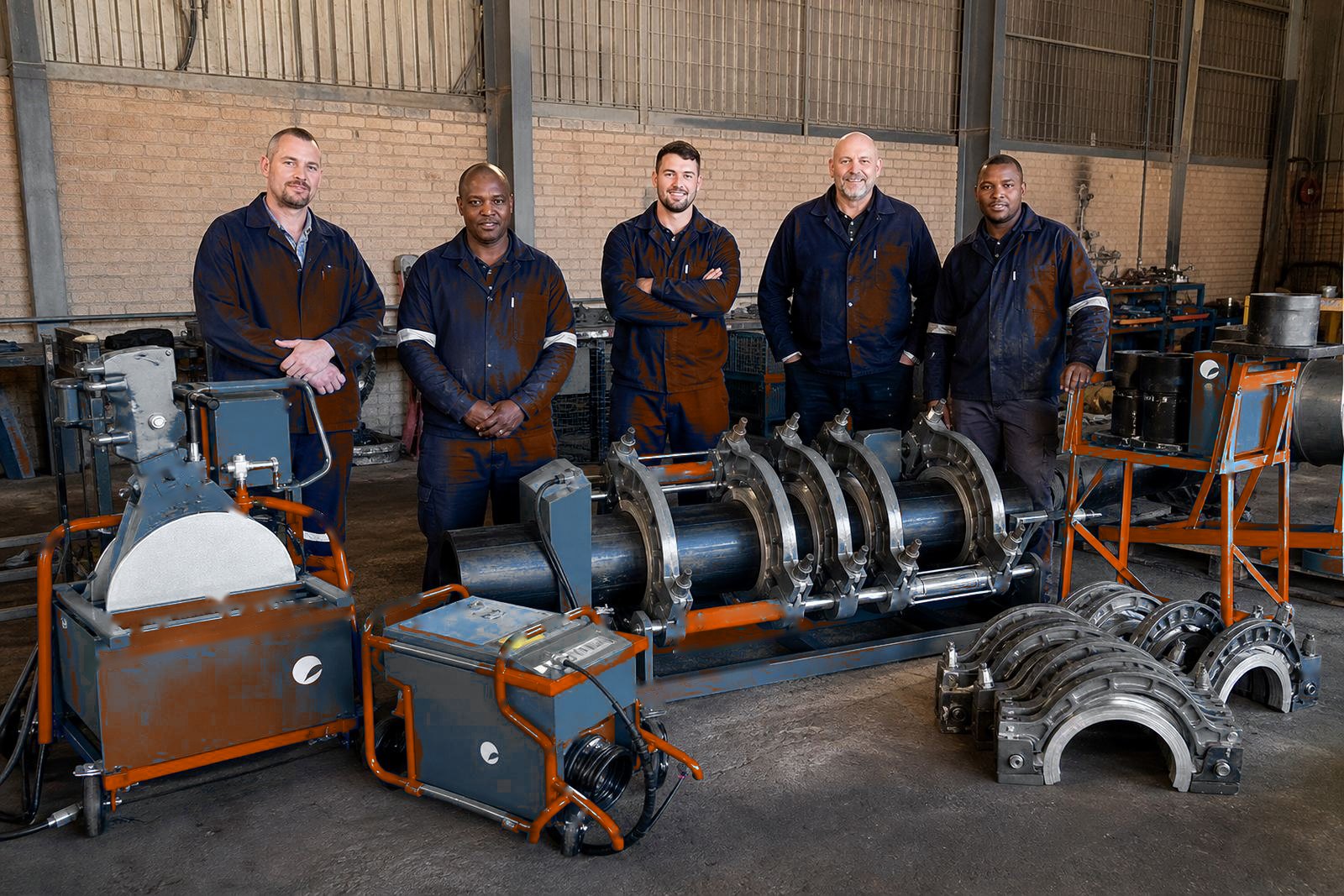
The workshop behind the machines
Support reaches Johannesburg, Rustenburg, Polokwane, Durban, Cape Town and projects farther afield. PlasticWelder concentrates on butt-fusion equipment for HDPE pipe and the service work around it.
Our day-to-day work sits close to the realities of site crews and workshop teams. Small diameters suit a compact machine, and larger pipe calls for equipment with tighter clamp alignment and consistent data logging. We keep the equipment and support practical, so crews can work with fewer stoppages.
Being based in Wadeville gives us access to the industrial routes, storage yards and contractor traffic that shape this trade. It also means we know the pressure points on a job, from a pump line repair to a planned civil run in windy coastal conditions where dust, moisture and handling all affect the weld.
- Butt-fusion HDPE pipe welding machines
- Hire, servicing and operator training
- Support for shop, yard and site work
How our team handles the work
The team is led by Mandla Maluleke, with Riaan Salie coordinating operations, Ayanda Naicker handling training, Leanne Matlala supervising servicing, Thabo Mabena in the field and Alicia Jacobs managing hire. Our work calls for mechanical skill and careful judgement from that combination. It is also about how a crew sets up, checks, records and finishes a weld under real site pressure.
We work in a way that keeps the machine, the pipe and the operator in the same conversation. Before a weld, the pipe ends need to be clean and square. Facing must remove the right amount of material without leaving a poor edge. Heating has to be even across the face before the plate comes out.
Once fusion pressure is applied, the joint needs to hold that pressure through the cooling period without movement. Joints stay still and under pressure until the cooling time on the weld sheet has passed.
- Refresher training for changing site teams
- Site startup help for first welds and setup checks
- Weld logging help where records must be tidy
What we look for in a sound weld
If the setting is wrong, the bead can look uneven or the joint can end up stressed before it has even cooled.
We pay attention to bead shape, pressure consistency and whether the joint stayed aligned through the cycle. Logged temperature, pressure and cycle values go into site records and help when repeat work is audited.
Our work is to help crews avoid that kind of waste, especially on water, mining and civil lines where rework costs time, fittings and labour.
- Pipe sizes from smaller service lines to large diameter runs
- SDR-based settings matched to pipe wall thickness
- Bead inspection after the joint has cooled
- Data logging support where records are needed
Hire, servicing and machine care
Short-phase hire and servicing of owned machines make up roughly equal parts of the workshop diary. We handle both. Hire fleet prep records machine condition on dispatch, and collection inspection lists what comes back needing attention.
Heater plate checks, facer overhaul, clamp alignment and hydraulic pressure tests all help keep the machine within spec in use. If a plate is uneven, a facer is dull, or the clamps are out of line, the weld can drift before the operator notices. Each service sheet lists the parts checked and the work done on them.
In a trade that deals with pipe by the metre and joints by the sequence, a fault on one machine repeats on every joint it makes. We keep spares support close to the equipment itself, so the job can move from inspection to correction without unnecessary detours.
- Machine servicing for routine and corrective work
- Heater plate checks for even heat transfer
- Facer overhaul and cutting edge attention
- Clamp alignment and hydraulic pressure test work
Hands-on teaching at the job
Training has to fit the way contractors actually work. Some crews are new to butt-fusion, others have experience but need a reset on heat soak, changeover time or logging. We keep the instruction grounded in the equipment in front of the team and in practical use once the machine is switched on.
Ayanda Naicker coordinates training around the people who will use the machine, and Thabo Mabena shows setup and site checks in the field. That can mean a first weld on a fresh line, a refresher before a larger run, or site startup help when the crew needs a steadier routine.
People learn faster when the sequence is clear. The team keeps those steps in the same order on every joint.
- Operator Training for new users
- Refresher Training for existing crews
- Site Startup Help for early welds and set-up
Where our support reaches
Contractors from Johannesburg, Rustenburg, Polokwane, Durban, Cape Town, Mpumalanga and the Northern Cape are served from Wadeville. The work changes by region. Inland sites can deal with dust, hard handling and long pipe movements, while coastal work has to watch moisture, storage and surface condition more carefully.
The same machine may work in very different settings across these regions. A mining crew and a municipal water contractor will not ask for the same sequence every time, and a civil team may need a different balance of hire support, servicing and training. We keep the approach grounded in the pipe, the pressure and the site layout.
In this trade, we prefer to work from the pipe size, SDR, quantity, site location and the type of weld expected.
- Johannesburg Support and Wadeville Germiston
- Rustenburg Support and Polokwane Support
- Durban Support and Cape Town Support
- Mpumalanga Sites and Northern Cape Support